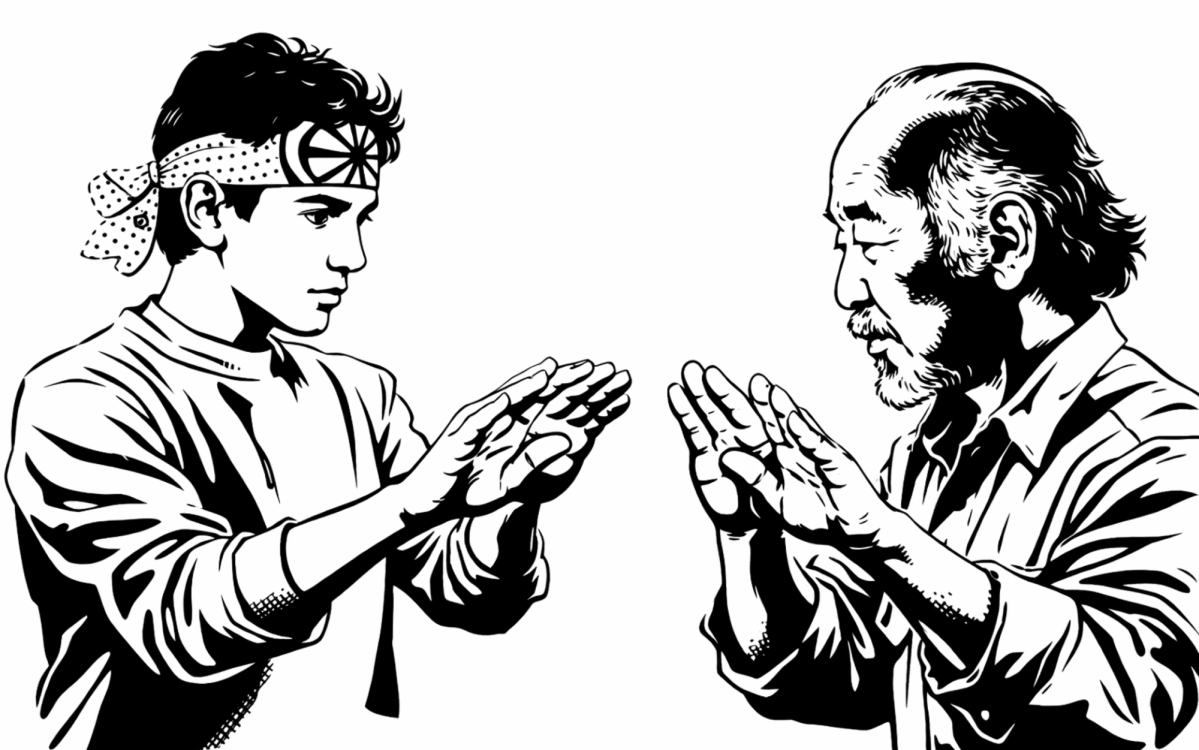
First Learn Stand, Then Learn Fly. Nature Rule, Daniel-san, Not Mine.
Mr Miyagi, The Karate Kid
Wax on. Wax off. Begin
What do you think about “gap” years?
I was asked this question again recently, and it struck me how different my answer is today from the one I might have given at the start of my career.
As a leftie, I was never entirely at ease with the idea of a “gap” year. In my day, and in my context, not everyone in my school was expected to go to university. Many went straight to work, and we talked about “finishing” school rather than “graduating” from it. The “gap” year, if it came up in conversation, often felt like a euphemism for travelling, swanning around, or backpacking around the world at their parents’ expense. I had always perceived it to be an immense flex, a luxury reserved for the privileged few. It was as if they had been selected for a different kind of beginning. It wasn’t for me.
When I finished school, I wasn’t trekking through the Andes, nor working bars along the Gold Coast, and certainly not handing out sports equipment between village stops on my African safari. In my “gap” before starting my teacher training (five months), all I had to show for was the tiredness of working two jobs, the wreckage of a girlfriend breakup, and the underrated glory of finally winning Sid Meier’s Civilization on Emperor level. The furthest I travelled was ten minutes on the train into Brighton to spend that hard-earned salary drinking whilst watching the England football team play, heroically and then tragically, in Euro ’96.
And so, for a long time, I guess I was resentful. Perhaps I would have loved to go on one of those gap-year quests of discovery.
Indeed, I grew up surrounded and inspired by quests. Harry Potter leaves the ordinary world and discovers that he must confront forces far larger than himself, guided by mentors and sustained by friendship, but ultimately responsible for his own choices. Frodo leaves the safety of the Shire, sustained by the Fellowship, but is ultimately responsible for carrying the One Ring himself. Luke Skywalker leaves Tatooine with the guidance and friendship of Obi-Wan, but must eventually confront his destiny and Darth Vader alone.
What these quests share is simple: growth does not happen by staying where you are. It happens by leaving and taking on responsibility, by discovering what you are capable of carrying.
And whilst we understand this instinctively in stories, we seem less comfortable granting it in life.
Quest 1: The quest to find your feet
We call it a “gap year”, but what I have come to see, after years working with young people at the threshold of adulthood, is that this period is not a gap at all.
It is a beginning.
The problem is that, after eighteen years of life, young people have just emerged from the most structured and supervised childhood experience in human history. Between parents and schools, we’ve organised their time, attention, and expectations. We’ve decided what matters and when. We’ve shown them how to succeed in the systems designed for them. We’ve scaffolded their childhood. We’ve protected them.
But have we prepared them for their first quest?
Are they ready to find their own way?
Are we ready to let them go?
At some point, the scaffolding comes down. It has done its job. And it is only at this point (this beginning) that young people commence the first quest of adulthood: the quest to find their feet.
I remember my own version of this moment.
For the first time, my time belonged to me.
I did not realise it at the time, but I can see now that I became an expert in relationship breakdowns. I learned realpolitik and resource management through my 10,000 hours of Civilization gameplay. I learned to manage my expectations from watching the England football team. And I learned accountability and personal finance simply by working.
None of it looked like progress at the time, but looking back, it was my Mr Miyagi gap year.
Mr Miyagi
In The Karate Kid, Daniel does not learn karate by practising karate. He paints fences. He sands floors. He waxes cars. It is both ordinary and pointless, and Daniel becomes frustrated because he cannot see how any of it connects to achieving his quest.
It is only later that he realises what he was really developing: balance, discipline, technique, and core strength.
The lesson was hidden inside the doing.
Each person’s quest to find their feet will look different. It might involve travel, if they have the privilege to do so. But it might just as easily involve ordinary work, ordinary routines, and ordinary responsibilities. Whatever the case, with time and space, a shift will occur. They will stop living inside the life that has been designed for them and begin to build one of their very own.
It will be a beginning.
It is the first of several quests that unfold across adulthood:
- Quest 2: The quest to find your people.
- Quest 3: The quest to find your commitments.
- Quest 4: The quest to find your purpose.
But none of those later quests can truly begin until this one does.
You begin by finding your feet. And yet, beginning this quest has definitely become more difficult for young people.
Today’s youngsters have grown up inside systems that provide maps so detailed that little is left to the imagination. Their paths are carefully plotted and their progress closely guided. Their next steps are anticipated long before they arrive. They move from one structured environment to the next, over-supported, protected, and curated through every turn.
We teach them to quest without riddles, without false turns, and without long stretches of uncertainty where they must decide for themselves which direction to travel.
But the first quest cannot be completed by following someone else’s map.
It only begins when that scaffolding comes down. It only begins in the spaces without Dumbledore, without Gandalf, without Obi-Wan. When even Miyagi steps back.
Wax on. Wax off.
Begin.
Discover more from Serendipities
Subscribe to get the latest posts sent to your email.
 Serendipities