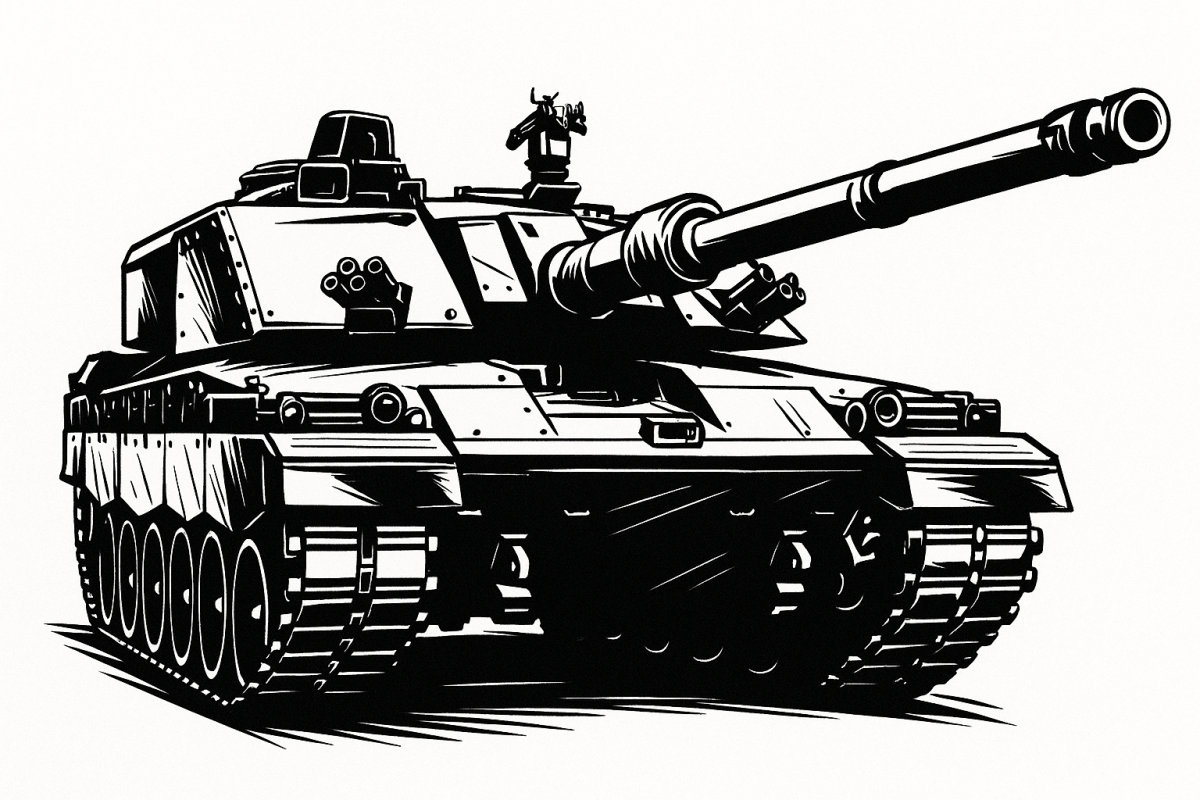
A classic trilemma: When you build a tank you can make it faster, more armoured, or more lethal. You can’t do it all.
The world feels increasingly binary these days.
Everything is reduced to its simplest, sharpest form:
You are either with us or against us. It’s black or white. You are right or wrong. It’s this or that. Left or right. With Israel or with Palestine. Pro or anti-phone bans. AI is either the harbinger of doom or a force for good.
Binaries are seductive. They give the illusion of clarity (and moral certainty) in a world that rarely offers any. And they tidy up the messiness of life into neat lines of argument and opposition. They represent the ultimate form of reductionism, the home of polarisation (and dehumanisation).
My life is full of problems to solve in parenting, school leadership, management and relationships. None of these ever fit neatly into an “either/or.” And yet we still reach for that language, because our minds are happy to settle for such simplicity.
Then, in our world reduced to binaries, is it any wonder that we also find ourselves reducing the world’s problems into dilemmas to resolve?
I want to share a proposition:
We do not live in dilemmas. We live in trilemmas1.
Trilemmas are situations with three competing tensions, three valid logics, three forces pulling us in different directions.
You solve dilemmas; you have to balance trilemmas.
The first time I heard about trilemmas was during my military education. If you want to build a tank, I learned, at some point you have to decide between a series of brutal trade-offs:
- Lethality – add more firepower to win a fight.
- Speed – add more speed to move first and fast.
- Protection – add more armour to survive a hit.
Add lethality, and you often compromise protection and speed; add too much protection, and you slow the vehicle down; prioritise speed, and you end up having to reduce armour or weapons.
I learned that every tank lives inside a trilemma.
Actually, I learned that the perfect tank does not exist.
It was the first time I realised that every system – from warfare to schools to welfare – is not defined by its intentions but by its compromises.
It’s fair to say that once you start seeing trilemmas, you can’t stop. And then I started noticing them everywhere I went: in my policy work, pedagogy, DEI, teacher recruitment, budgets, school timetables, and my leadership and management.
This week I have been preoccupied with two particular trilemmas: school admissions and innovation in the IB Diploma.
The School Admissions Trilemma
This is not a trilemma unique to my school, but it probably takes up the most bandwidth.
Like many, our school would wish to be:
- To be inclusive.
- To be full.
- To provide attractive student outcomes.
They each sit in tension. If you prioritise being full and attractive (prestigious?), you risk exclusion if you start only selecting students who you think might contribute to that prestige. If you prioritise inclusion and attractiveness, you also risk not being full, as both require smaller cohorts and may entail higher costs. And if you prioritise being full and inclusive, you might risk being attractive to families who value your exam results and university destinations.
Perhaps the important thing is that we recognise that a trilemma exists in the first place.
That said, I am almost certainly doing an injustice to the constellation of tensions within the admissions process (as I have not even mentioned that we also want to be diverse, to be equitable…) that probably stack up to a decalemma.
The IB Diploma Trilemma
My second preoccupation this week concerns the IB’s Diploma Programme.
As one of many people (including past and present IB folk) who have had a hand on the tiller of reviewing the IBDP, which has been a running project for the best part of 15 years2, I never found it easy to explain why upgrading the DP was so difficult. Whilst some aspects of the DP’s overall structure have evolved over the last 50+ years, much has endured. In essence, the DP is a 50+ year-old, well-loved, but ageing tank. It is the product of trade-offs made in a different era.
Unlike most trilemmas, the trade-offs in the IBDP actually hide in plain sight. The IBDP is a meta-trilemma:
- International – philosophical aims (educating the whole child, intercultural understanding, making a peaceful world, etc).
- Baccalaureate – educational aims (balanced, arts and sciences, connected, doers, not just knowers, authentic assessment, inquiry, learning to learn, etc).
- Diploma – pragmatic aims (portable qualification, prestigious university recognition, etc).
The IB Diploma sits in this trilemma. And, like the tank, I’m sorry to share that a perfect IB programme does not exist.
If you make it too philosophical or pragmatic, you might risk losing the educational value proposition. If you hold onto the educational or pragmatic aims too tightly, you might end up being just another generic end-of-school exam. Or, if you are not prepared to shift from the original philosophical or educational aims, you might end up with a Diploma that does not meet the needs of different national systems, or a generation of learners who want more voice, choice and agency.
Again, people are looking for a perfect IB Diploma. But it does not exist. I have yet to meet two people who stand in the same spot within the IB Diploma trilemma triangle. What’s valued in US public schools, for example, is often different from what private international schools might seek.
In the end, the best way to move forward with the IBDP review3 (upgrade) is to follow the path now set by the IB. That involves inviting schools to pilot innovations around the current IB model, to stretch and stress-test various tensions in the trilemma, and see what we might end up with… accepting that some innovations will work, some won’t.
Here are some of the innovations being piloted by the IB:
- Systems Transformation: This innovation stress-tests the IBDP by allowing greater flexibility in students’ subject choices. When students choose to take the Systems Transformation course, it counts as a double SL course. Students can then select three HL courses and a further SL course, with the caveat that they must make one selection from Group 1 or 2 and one selection from Group 4 or 5. Students are still awarded a Diploma out of 45 points, but you can imagine how the trilemma teases out a “compromise” in which students choose not to immerse themselves in two languages as part of their International education. Or the “compromise” caused by narrowing the breadth of the Baccalaureate. Or where the Diploma is awarded outside of the established passing conditions.
- Online IB Diploma: An innovation whereby students can complete the entire IB Diploma online. Trilemmas everywhere.
- Open Book Exams: An innovation whereby students are allowed to bring pre-annotated texts or summaries into their exams. Trilemmas everywhere.
And there are several other innovative pilots… but you can probably work out the pilot my school is excited to be running just now.
So What?
Dilemmas, trilemmas, decalemmas…so what?
I started this reflection as a reminder that the world conspires to reduce complex issues, problems, and tensions into small parts: binaries and dilemmas for the most part.
I wanted to lift my thinking to the level of trilemmas. And I’ve found that once I break free from the binaries and dilemmas, it is clear that those complex issues we have to deal with are rarely trilemmas either. Things are just so complicated. Nothing is easy.
So the learning, the leadership lesson, the “so what?” is to remember to notice when the mind is reaching for simplicity—for easy—and to pause instead.
It’s helpful to name the tensions before you try to resolve them.
It’s wise not to lead by claiming certainty, but by sharing complexity.
Leadership, in the end, is not about eliminating those tensions. It’s about naming them, owning them, and helping to balance them. Of course, there will be compromises, but you will know what you have compromised, and others will trust that your judgment is sound.
And finally, it’s worth remembering that if nothing is easy, then you are probably doing it right!
- And tetralemmas (4 tensions), or hexalemmas (6) and even decalemmas (10) ↩︎
- Although it was only formally commenced in 2019. ↩︎
- Sensibly broadened to include both the Career-related Programme (CP) and the Diploma Programme (DP). ↩︎
Discover more from Serendipities
Subscribe to get the latest posts sent to your email.
 Serendipities
2 replies on “Trilemmas, Not Dilemmas”
[like] Nargish Khambatta reacted to your message:
LikeLiked by 2 people
Life is simple, its just not easy! So seems to apply to the IB! I keep telling my daughter thtt genius is in making complicated things simple! Confusion is always expensive (ito time & effort)! Leaders, teachers & parents should strive to be te translators between complex & clear; when they do so, (n)lemmas should reduce and decision-making become less tedious
LikeLiked by 1 person