I am trying to decide whether I have read a lot of books this year or not.
Not that it matters, of course. I’m not counting. It’s just that I know that reading is a great place for me to “be well”, and that does matter.
As much as I would love to have a library room where I keep all my books (books I have read, intend to read or will never read), life on the road means I have to settle for a single bookcase. Each year, therefore, I sit down with a glass of wine to decide which books I will add and which will sadly need to find a new home.
Three books have “made it” onto my shelf this year. Whatever anyone else thinks of these books, the point is that they resonated with me last year because they clicked with something already on my mind or because they are inherently good.
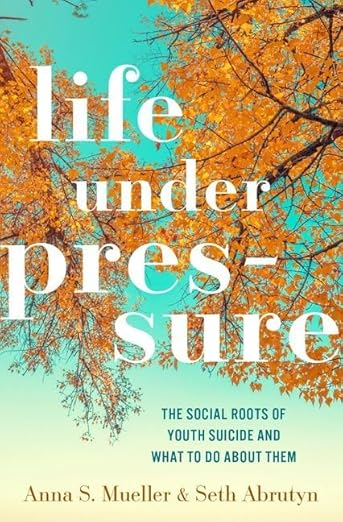
Life under Pressure: The Social Roots of Youth Suicide and What to Do About Them
by Anna Mueller and Seth Abrutyn
Why this one means something to me:
So many reasons. Firstly, the lack of understanding around the taboo of suicide. Secondly, the sad truth is that it affects so many. Thirdly, we (all) can help do something about it. Mueller and Abrutyn show how social environments can cause suicide and how they can be changed to help kids discover a life worth living.
I came across this book whilst reading the (I thought disappointing) latest book from Malcolm Gladwell, Revenge of the Tipping Point. Gladwell was trying to understand why one particular school in a small community found itself coming to terms with a disproportionate number of suicides over a relatively small period.
I went down the rabbit hole and found that I wanted to read the whole story. I am glad I did. All School leaders should read this. It’s our work.
Here are a few quotes I highlighted:
“We all need to build competence in talking about suicide and mental health in effective and non-stigmatizing ways. This isn’t easy.”
“An intentional, well resourced prevention strategy is, in fact, a perfect fit for school settings, but few schools have either.”
“Let us be very clear: research has repeatedly shown that talking about suicide does not cause suicide and likely protects against it.”
No Rules Rules
by Reed Hastings and Erin Meyer

This book came to my attention because one of the co-authors, Erin Meyer, wrote The Culture Map, which is essential reading for anyone working across cultures – and perhaps those who don’t.
Why this one means something to me:
No Rules Rules is a book about organisational culture. When your workplace has a high-talent density, you can (and should) reduce the volume of rules and policies that act as shackles to innovation, agility, and trust – all things high-talent needs to thrive.
In reducing rules, organisations should inversely ramp up continuous feedback loops for employees – a version of radical candour – to ensure they know what they are doing well and what they need to improve.
Finally, the book champions the benefits of leading with context over control (rules). Don’t spend inordinate amounts of time telling people what they can and can’t do; give them context and the space to get on with things.
We can learn something from this approach. I don’t think staff or learners can be at their best if they work in high-rule (low-trust) schools. I don’t want to discuss the length of socks someone should wear. I have more exciting things to do, as do the kids.
Here are a few quotes I highlighted:
“In a fast and innovative company, ownership of critical, big-ticket decisions should be dispersed across the workforce at all different levels, not allocated according to hierarchical status.”
“Lead with context, not control,” and coaching your employees using such guidelines as, “Don’t seek to please your boss.”
“It made our workforce smarter. When you give low-level employees access to information that is generally reserved for high-level executives, they get more done on their own. They work faster without stopping to ask for information and approval. They make better decisions without needing input from the top.”
Team of Teams
by General Stanley McCrystal

This book was the inspiration for one of my favourite blogs this year: Beware the Dinosaur’s Tail.
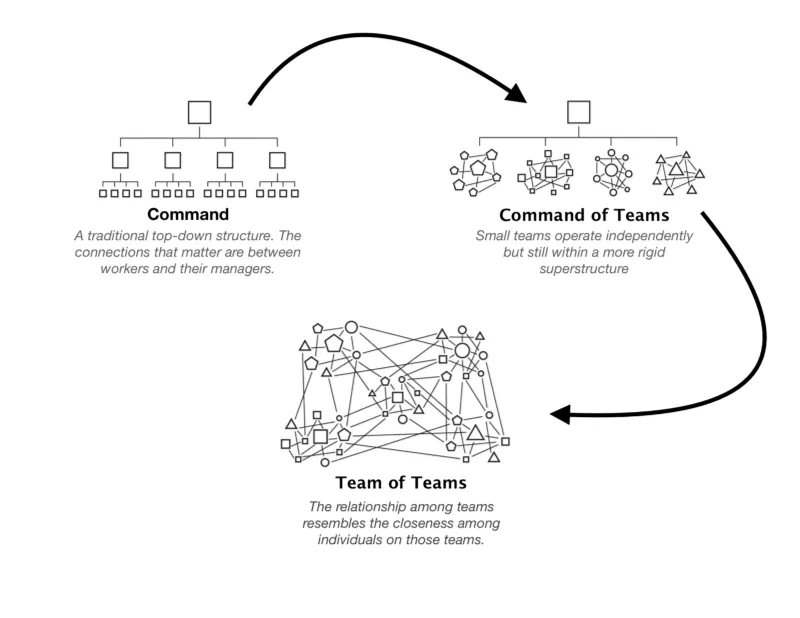
Here is the pictorial summary of the book:
Why this one means something to me:
Firstly, I have a little something in common with the author, General McCrystal: we both served in Iraq and Afghanistan around the same time.
The book’s main message is that reductionist hierarchical management techniques no longer work because organisations are too large for one person to make all the decisions.
Think about how your own school is organised.
McCrystal says it’s better to create a shared consciousness in your organisation by sharing information and building genuine relationships and trust. Once you have shared consciousness, focus on empowered execution, where anyone in the organisation can take action without needing approval as long as they provide all contextual information to leaders. Leaders can then take an eyes-on, hands-off approach to management. Then, instead of executing, they can focus on fostering an environment conducive to shared consciousness and empowered execution.
Fundamentally, organisations need to be robust and adaptable. Old reductionist management is robust but not adaptable. Adaptability is less efficient but essential in a complex world.
There is so much here that resonates with my first book choice above, No Rules Rules. Decentralised structures and high trust are how organisations thrive.
Is this how your school operates? If not, why not?
Here are a few quotes I highlighted:
“Efficiency remains important, but the ability to adapt to complexity and continual change has become an imperative.”
“Organizations must be networked, not siloed, in order to succeed.”
“The temptation to lead as a chess master, controlling each move of the organization, must give way to an approach as a gardener, enabling rather than directing. A gardening approach to leadership is anything but passive. The leader acts as an “Eyes-On, Hands-Off” enabler who creates and maintains an ecosystem in which the organization operates.”
So there you have it. My 3 books for school folk in 2024.
With no promises for 2025.
Cover picture from Phoebe Capelle
Follow Serendipities by Email
Enter your email address to subscribe to this blog and receive notifications of any new posts by email:
Discover more from Serendipities
Subscribe to get the latest posts sent to your email.
 Serendipities
One reply on “The Best 3 Books (for School Folk) in 2024”
[…] The Best 3 Books (for School Folk) in 2024 The Best 3 Books (for School Folk) in 2023 […]
LikeLike