
When communication systems grow large enough, the problem is rarely the number of messages. It is the uncertainty around them.
A few weeks ago, colleagues surfaced something we all know has become a source of pressure across the school.
Can we do something about email?
At first, it sounded simple enough. But the more we talked, the clearer it became that email was only part of the story.
Because teachers do not just receive communication. They sit at the epicentre of it all.
Around them, we have built an ever-expanding vortex of tools designed to help them communicate and organise. If an email does not get a response quickly enough, there is always Google Chat — we are, after all, a Google-powered school. Or Google Classroom. Or WhatsApp.
The message will get through if we hit the right channel.
And so the teacher has them all on. Ready. Responsive.
Students message teachers with clarification questions, for extensions, for reassurance – at all hours. Parents are the same. And colleagues and heads of department are in on the action too.
Are you coming? Can you read this? Can you send Faith down to reception to pick up her swimming kit? Did Robin arrive on time this morning? Can you upload your assessment grades, please?
On the way to school. While teaching. Between lessons. After school. After supper. After lights out.
Always on.
Objectively, each message is reasonable. But what struck me in those conversations was not frustration but a resignation that does not show up as a complaint but as a question people ask themselves almost apologetically: Was it always like this?
We are no longer talking about the occasional busy week. Schools have always had those. But there is now a constant expectation that we set aside some of our attention to stay on top of things.
My colleagues are asking for help.
Only Variety Can Absorb Variety
The cyberneticist W. Ross Ashby once observed that systems must develop enough variety to cope with the complexity of their environment. Put more plainly: the more complex a system becomes, the more complex its responses to that complexity will need to be.
You cannot manage a hundred moving parts with a simple set of signals. The signals have to multiply too.
Schools are about as complex as human organisations get. In my school, we are talking about thousands of students from diverse families, with differing values, languages and cultures, spread across time zones, each with their own expectations around safeguarding, trips, events, behaviour and boundaries…
It is therefore not surprising that our communication systems have evolved to match that complexity. Email alone could never coordinate all of this. So organisations adopt messaging platforms, collaborative documents, chat channels and notification systems. Each new tool solves a real coordination problem. Each is adopted for good reasons, usually by people trying to make something work better.
But something happens once a system develops enough variety to manage complexity. It becomes harder to navigate. And once it becomes large enough, its movements begin to have unexpected effects, not because anyone intended harm, but because that is what complex systems do.
The system is not broken. It is doing exactly what systems do when they grow large enough to serve the complexity they were built for.
And that is what makes it so difficult to address.
What We Are Actually Talking About
Before grasping for explanations, it is worth being precise about what the problem actually is.
I am not convinced this is simply about too many messages. That is a description of the system, not a diagnosis of the harm.
As Herbert A. Simon observed more than fifty years ago,
“What information consumes is rather obvious: it consumes the attention of its recipients. Hence a wealth of information creates a poverty of attention.”
Information does not simply inform; it consumes the attention of those who receive it.
What my colleagues were describing is not, at its core, an inconvenience. It is more of a slow encroachment on the conditions that make teaching sustainable.
Teaching is cognitively total work.
It requires complete presence in the room. And it requires recovery between rooms. Neither is straightforwardly available when a portion of your attention is permanently reserved for channels that remain open, because the system has been built on the assumption that you are reachable, and you have internalised that assumption as an obligation.
The problem, in other words, is not the volume of communication. It is its reach, particularly when that reach extends into the spaces where recovery is supposed to happen.
So…The Dinosaur…
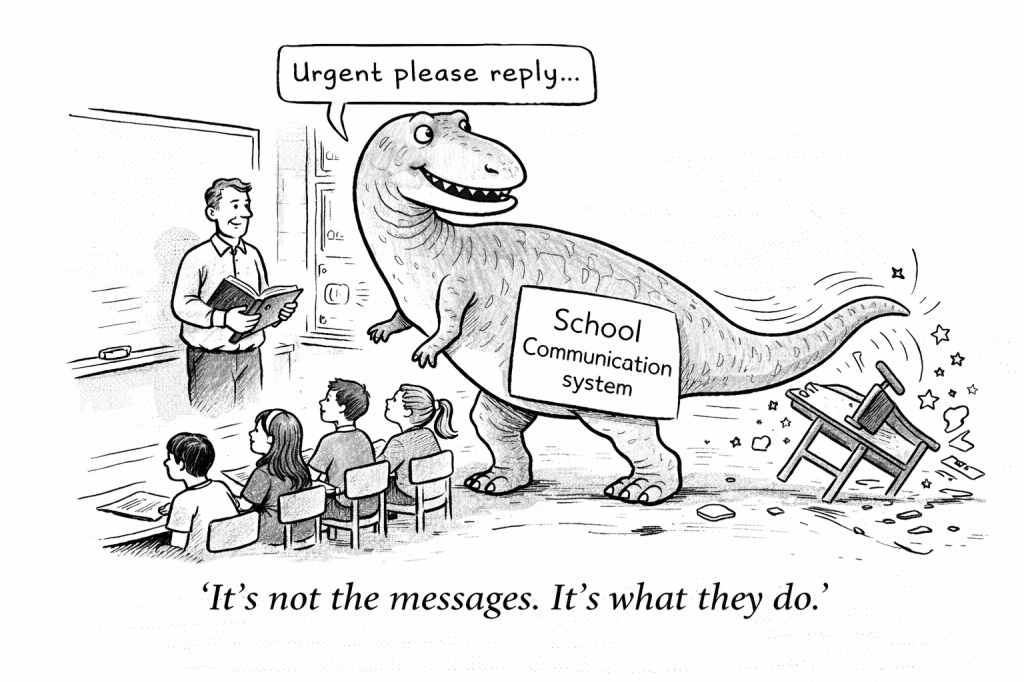
There is an image I have returned to more than once: a dinosaur moving through a room.
The head moves first. The body follows. And some distance behind, the tail swings through the space, occasionally knocking over chairs and tables.
The interesting thing about the tail is not the damage. It is the delay. Its effects arrive later than the movement that caused them. By the time anyone notices, something has already been knocked over, and the head has long since moved on.
In an earlier piece, I used this image to describe leadership: the unintended consequences that follow even the most well-intentioned decisions. The more senior the leader, the longer the tail.
But what strikes me now is that the phenomenon is not confined to leadership.
Everyone has a tail.
And in a sufficiently complex communication system, those tails are everywhere swinging through rooms the sender never enters, at times they are not aware of, long after they have moved on.
Students message because they need help. Parents write because they can. Colleagues coordinate because schools are complex places to run. Leaders communicate because information must flow.
Each movement is reasonable. The system amplifies every one of them.
No single person is responsible for moving the dinosaur. But together, we keep it walking.
The Leadership Tail
There is, however, one part of this I find difficult to ignore and the need to be empathetic. As I’ve said, the more senior a leader becomes, the longer their tail grows.
A teacher sending a message might affect a handful of colleagues. A middle leader might affect a department. A school leader sending a message might affect hundreds, and by the time its consequences ripple through replies, clarifications and decisions, the person who sent it has often moved on entirely.
This is not a problem of intention. It is simply how complex systems behave.
The head moves. The organisation experiences the tail.
I am aware that I move the dinosaur more than most people in my building, and that I probably feel its tail the least. That asymmetry matters because what feels like a small movement at the head can feel like a significant disruption further down the system.
Why Rules Won’t Fix This
When colleagues raised this, they were not seeking fewer tools (I don’t think). They were asking for clarity.
Clarity about which channel to use. Clarity about when a response is expected. Clarity about when silence is acceptable.
The temptation (and I have felt it) is to respond with policy. Define the platforms (email only). Specify response times (e.g., 72 hours unless urgently required). Set boundaries around when communication should and should not take place (e.g., 7am-7pm).
There is some value in that. But I am not convinced rules alone will solve this.
Rules about when messages can be sent do not remove the underlying uncertainty about how they will be received. They do not change the felt expectation to respond. And in a school built on professional trust, an overly rule-driven approach risks signalling something corrosive, that people cannot be trusted to exercise judgement.
There is also the problem of the tail. Policies operate at the level of individual messages. But the pressure my colleagues describe is not created by individual messages. It is created by the accumulation. By the system. And systems do not always respond predictably to rules.
What We Will Try
And yet, doing nothing is also a choice (I know my Nudge Theory).
So we will need to try some things, knowing they are partial.
We will try to be clearer about which platforms are used for what, not to restrict communication, but to reduce the ambient uncertainty about where to look and how urgently to respond. We will try to establish shared language around response expectations: not rigid rules, but clearer signals about what requires immediacy and what does not. We will try to create more space for professional restraint — not restraint as neglect, but restraint as the ordinary condition of someone who is teaching, thinking, or simply not available.
And we will try to become more conscious of the tails our messages create. Especially those of us whose messages travel furthest.
These are not solutions. They are attempts.
The Tail We Leave Behind
The colleagues who raised this were not complaining about communication.
I think they were noticing the tail.
The way small movements at the head of a system ripple outward through dozens of people and channels, creating work and pressure long after the original message has been sent. The way a reasonable request becomes, in aggregate, an unreasonable weight.
Modern schools cannot shrink the dinosaur. Too many people are already riding it.
But perhaps we can become more aware of how it moves.
Because the real problem in always-on organisations is rarely the number of messages. It is the uncertainty around them. When people do not know which channel to use, when a reply is expected, or whether silence is acceptable, the safest response is constant attention.
And constant attention, sustained over time, is debiliatingly exhausting.
I do not have a neat answer to offer. What I have is a commitment to keep noticing, in conversation with the people who raised this, and an acknowledgement that moving a dinosaur, even slightly, takes more than one person deciding to move differently.
The head moves. The tail follows.
What we do about that, together, is still being worked out.
Discover more from Serendipities
Subscribe to get the latest posts sent to your email.
 Serendipities