A Review of the Standard Type Framework (1958–2037)
Extract from the National Institute for Productive Development, 2075 Retrospective Edition
Prefatory Note
Systems rarely falter because they lack standards. More often, they falter when the story that justifies those standards begins to thin.
I write this as someone who works within a high-performing, mission-aligned educational institution, one committed to both rigour and to preparing young people to serve something larger than themselves. In recent years, we have made deliberate shifts in our own structures: rethinking examinations, broadening definitions of success, and placing greater emphasis on purpose, service and global responsibility. These changes are not a rejection of excellence. They are an attempt to ensure that excellence does not become self-referential.
The allegory that follows imagines a Republic devoted to the production of excellence at scale through what would become known as the Standard Type Framework. The allegorical form adopted here acknowledges earlier examinations of merit and excellence, most notably those of Michael Young and William Deresiewicz, whose work continues to shape contemporary reflection on performance and purpose.
The concern is not excellence itself. The concern is the gradual consolidation of privilege that can occur when performance metrics stabilise across generations. But it is also a question of purpose. Where aspiration persists without credible mobility, refinement alone cannot sustain belief in the fairness of the system that sorts. And where optimisation narrows imagination, success may become insufficient to the demands of the future.
The legitimacy of the Framework, its outcomes, and the hierarchy it sustains is not secured by success alone; it must be renewed through evolution.
i.
The Standard Type (1958–1965)
In the mid-twentieth century, sheep-rearing across the Republic was marked by variation. Flocks differed in temperament, fleece density, grazing pattern and responsiveness to direction. Shepherds relied upon local judgment and inherited practice. While such diversity reflected regional character, it produced inconsistency at scale. Traders struggled to guarantee uniform output; comparisons across valleys were unreliable. Excellence lacked a shared definition.
The National Commission on Productive Livestock concluded in 1964 that fairness and productivity required standardisation. Trials demonstrated that sheep displaying disciplined grazing, docility under structured guidance and predictable fleece density responded most effectively to formalised breeding and conditioning regimes. These characteristics were consolidated under the designation of the Standard Type — not as a statement of intrinsic worth, but as a model capable of consistent reproduction at scale. Once ratified in 1965, this model formed the foundation for what became known as the Standard Type Framework.
National Grazing Indices were introduced. Annual league tables ranked pastures according to Standard Yield Output. Inspection authorities enforced fidelity to breeding and conditioning protocols. Public confidence rose.
Rigour and fairness became increasingly synonymous with measurement.
ii.
Conditioning and Prestige (1965–1985)
The early decades of the Standard Type Framework were marked by stabilisation and rising performance. Variation persisted, but it became visible and manageable. Sheep exhibiting superior Standard Traits were eligible for transfer to the High Pastures — prestigious reserves associated with enhanced opportunity and status. Admission thresholds were published annually. Advancement was determined by performance within the Standardised Framework.
Conditioning intensified. Tolerance bands narrowed. Traits once regarded as idiosyncratic were reclassified as inefficiencies requiring corrective intervention. Auxiliary Alignment Academies and Structured Grazing Programmes proliferated. Participation rose steadily, particularly in regions where High Pasture matriculation was most competitive. Aggregate productivity improved.
Table 1. National Standard Yield and High Pasture Matriculation Rates (1965–1995)
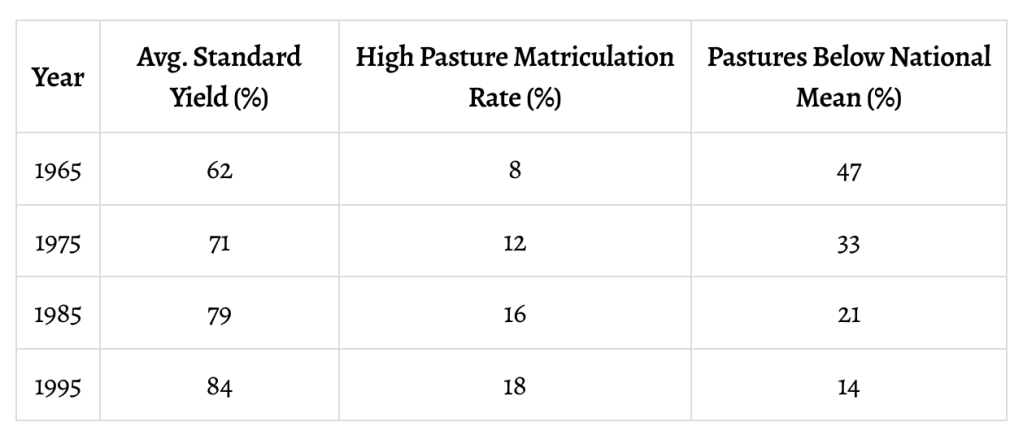
Yield rose. Underperforming pastures declined. Prestige attached itself to proximity to the Standard. The system appeared both fairer and more efficient.
iii.
Precision and Expansion (1985–2015)
Technological advances increased diagnostic sensitivity. Recognised trait categories multiplied. Sheep previously considered marginally divergent were reclassified into specialised corridors. Reconditioning cycles became more frequent. By the early 2020s, recognised categories had quadrupled, specialist placements had more than tripled, and average reconditioning cycles had risen accordingly. Reports of resilience concerns increased from single digits to over a quarter of assessed cohorts.
These developments were interpreted as progress in identification and rigour. Greater sensitivity was equated with greater fairness. The possibility that conditioning intensity itself might contribute to strain was rarely foregrounded.
At the same time, language shifted. High-performing sheep were increasingly described as naturally aligned. Lineage records acquired prestige value. Conditioning migrated from method to identity.
iv.
From Performance to Identity (2015–2025)
By the second decade of the century, excellence had begun to stabilise as descriptor rather than outcome. Sheep spoke of “being Standard enough.” Lambs were assessed early for alignment potential. Independent grazing was tolerated, provided it did not compromise metrics. Conditioning signalled not merely achievement, but suitability.
The early reform question, “How might we cultivate excellence fairly?” was replaced by another: “How reliably does this sheep approximate the Standard?” Deviation acquired existential weight. Success was increasingly anticipated; divergence increasingly explained.
It was seldom asked what kind of sheep the Framework ultimately sought to produce. The Standard Type had begun as a pragmatic solution to variability; it evolved into an aspiration and then into an identity. Excellence came to mean disciplined alignment, resilience under measurement and consistent yield.
Such traits are not without value. Stability sustains collective productivity. Yet the terrain beyond the marked pastures did not remain constant. Environmental conditions shifted. The Republic’s challenges grew less predictable.
Alignment ensured stability. It did not necessarily ensure adaptability.
The Republic had become highly proficient at producing sheep suited to the system it had built. Whether it was equally proficient at producing sheep capable of reshaping that system remained less clear.
v.
The Optimisation Decade (2025-2035)
Inspection regimes intensified further. Artificial Pastoral Intelligence systems reduced discretionary variance. High Pasture admission criteria were recalibrated annually to preserve distinction. Performance indicators strengthened.
Yet as yield rose, mobility slowed. High Pasture concentration within established lineages exceeded sixty percent. Entry increasingly required not only demonstrated alignment, but proximity to those already within. Performance and inheritance became progressively difficult to disentangle.
Meanwhile, non-alignment stabilised.
Table 2: Persistent Non-Alignment and Attrition Indicators (1995–2035)
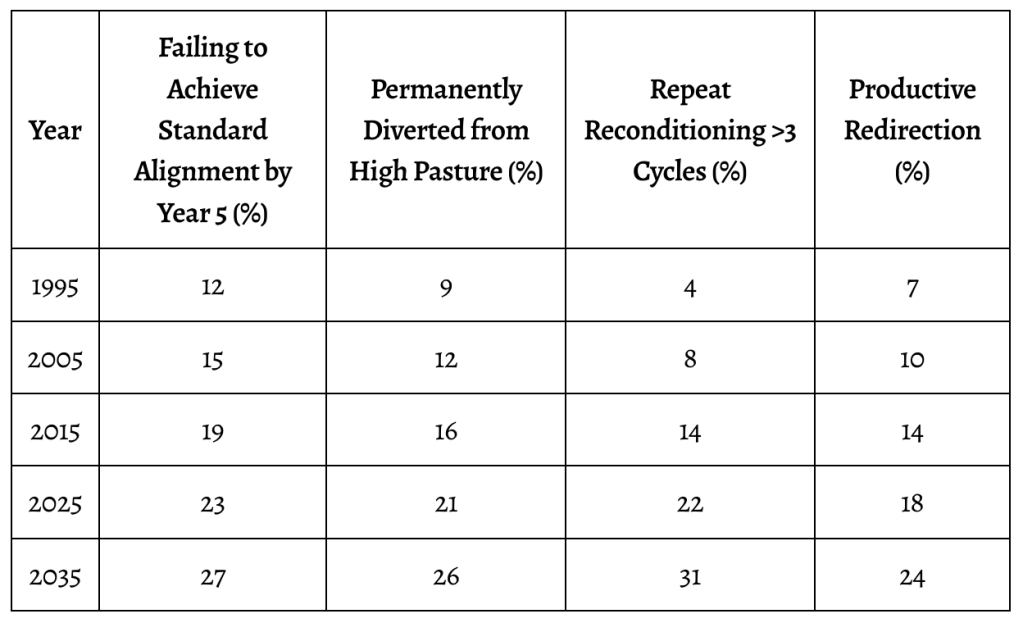
By 2035, non-alignment had become statistically ordinary. The system did not interpret this as failure. It interpreted it as sorting.
vi.
Structural Saturation (2036–2037)
By 2036, selective non-participation in High Pasture transfer pathways had extended beyond previously redirected cohorts, appearing for the first time among Borderline Standard flocks. That same year, transfer participation declined for the first time since the Framework’s inception, despite continued increases in measurable yield.
The system did not collapse. Instead, it initiated internal reviews and recalibration discussions under the National Legitimacy Commission.
When sorting becomes generationally stable, outcomes appear increasingly predetermined. As predictability hardens, confidence in upward mobility declines. Withdrawal, in such conditions, is typically gradual – and then sudden.
vii.
The Present Uncertainty
The Republic continues to produce record numbers of Excellent Sheep. High Pasture matriculation remains prestigious. Inspection regimes are rigorous; data robust; outcomes predictable.
Yet systems premised upon universal aspiration depend upon credible mobility. Where performance persists but privilege stabilises, belief in the fairness and usefulness of the Framework becomes more fragile than the metrics suggest.
The measures remain clear.
It is the willingness to be measured that now fluctuates.
— End of Extract —
Appendix 1: Chronological Record of the Standard Type Framework (1958–2037)
1958–1961 — Period of Regional Variability
1962 — National Commission on Productive Livestock convened
1964 — Standard Type trials completed
1965 — Standard Type Act ratified; Framework established
1968 — Inspection Authority Charter enacted
1972 — High Pasture Transfer Framework introduced
1978–1985 — Alignment Academies expand
1987 — Diagnostic Sensitivity Reform Act
1995 — National Standard Yield surpasses 80%
2003 — Reconditioning Protocol Review
2010 — Lineage Documentation Directive
2015 — Early Alignment Assessment Mandate
2020 — Artificial Pastoral Intelligence Integration
2025 — Optimisation Decade commences
2030 — High Pasture Lineage Concentration Review
2035 — Non-Alignment Stabilisation Report
2036 — Transfer Participation Decline Recorded
2037 — National Legitimacy Review Commissioned
References
Young, Michael. The Rise of the Meritocracy, 1870–2033: An Essay on Education and Equality. Thames & Hudson, 1958.
Deresiewicz, William. Excellent Sheep: The Miseducation of the American Elite and the Way to a Meaningful Life. Free Press, 2014.
The author acknowledges using ChatGPT as a drafting and editorial tool to refine tone and structure, particularly in shaping the allegorical voice of this essay in homage to Michael Young’s The Rise of the Meritocracy. All arguments, interpretations and conclusions remain the author’s own.
Discover more from Serendipities
Subscribe to get the latest posts sent to your email.
 Serendipities